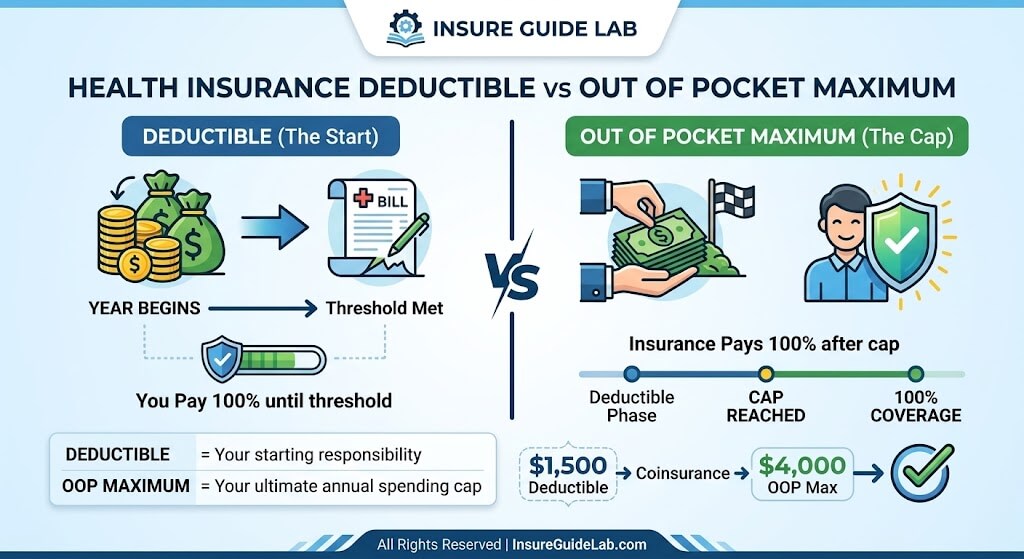
Navigating health insurance cost-sharing structures is essential to avoiding unexpected medical bills. When evaluating deductible vs out-of-pocket maximum, policyholders must understand at what stage insurance coverage begins and when personal financial liability completely stops.
While both metrics represent limits on what you pay for covered medical care, their financial thresholds, activation points, and cost-sharing mechanics serve two distinctly different roles.
Table of Contents
Quick Comparison: Deductible vs. Out-of-Pocket Maximum
| Feature | Health Insurance Deductible | Out-of-Pocket Maximum |
| Primary Definition | Amount you pay 100% upfront before benefits kick in | Absolute financial ceiling on your annual covered expenses |
| Coverage After Reaching Limit | Insurer shares costs (via Coinsurance / Copays) | Insurer pays 100% of all covered in-network medical costs |
| Typical Dollar Range | Lower ($500 to $3,000 for individual plans) | Higher ($3,000 to $9,450+ for individual plans) |
| What Counts Toward It | Direct medical bills for covered diagnostic services | Deductibles + Copayments + Coinsurance combined |
| Monthly Premiums Included? | No (premiums never count toward deductibles) | No (premiums do not count toward out-of-pocket caps) |
| Annual Reset Cycle | Resets to zero at the start of every new policy year | Resets to zero at the start of every new policy year |
What Is a Health Insurance Deductible?
A health insurance deductible is the fixed amount you must pay out of pocket for covered medical services before your insurance company starts paying its share.
- Upfront Medical Obligation: If your plan has a $1,500 deductible, you are responsible for paying the first $1,500 in eligible medical expenses before cost-sharing activates.
- Preventive Care Exceptions: Most ACA-compliant insurance plans cover routine annual checkups, vaccines, and basic screenings at 100% before you meet your deductible.
- Cost-Sharing Trigger: Once the deductible is met, your coverage shifts into a coinsurance phase (e.g., insurance pays 80%, you pay 20%).
What Is an Out-of-Pocket Maximum?
An out-of-pocket maximum is the maximum total dollar amount you are required to spend on covered healthcare services within a single policy calendar year.
- Ultimate Financial Safety Net: It protects households against financial catastrophe caused by prolonged hospitalization, intensive surgeries, or chronic conditions.
- Cumulative Metric: Every dollar you pay toward your deductible, office visit copayments, and percentage-based coinsurance accumulates toward this ceiling.
- 100% Insurer Coverage: Once your combined spending hits this upper threshold, the insurance carrier covers 100% of all covered in-network medical bills for the rest of the plan year.
5 Essential Differences: Deductible vs Out-of-Pocket Maximum
1. The Financial Role in Cost Sharing
The deductible is the starting line where insurance cost-sharing begins. The out-of-pocket maximum is the finish line where your personal out-of-pocket responsibility completely ends.
2. Dollar Threshold Spreads
Deductibles are set at lower financial targets to make initial cost-sharing reachable. Out-of-pocket maximums represent higher caps designed to contain severe catastrophic medical expenses.
3. Eligible Expense Counting
Only direct medical charges prior to coinsurance satisfy the deductible. The out-of-pocket maximum aggregates deductibles, prescription copays, and ongoing coinsurance charges.
4. Post-Threshold Insurance Payout Rates
After meeting your deductible, you still owe a percentage of every medical bill (coinsurance). After meeting your out-of-pocket maximum, your coinsurance drops to 0%, leaving the insurer to pay 100%.
5. Protection Scope Against Catastrophic Loss
Meeting a deductible does not prevent high medical debt if you face continuous treatments. The out-of-pocket maximum provides absolute legal certainty regarding the maximum sum you can lose annually.
Decision Checklist: Choosing the Right Policy Balance
Choose a High-Deductible / Higher-Maximum Plan If:
- [ ] You are generally healthy and rarely visit specialists or take maintenance prescriptions.
- [ ] You want lower monthly premiums to invest extra capital into a tax-advantaged HSA.
- [ ] You have sufficient emergency cash reserves to absorb the maximum out-of-pocket limit if an accident occurs.
Choose a Low-Deductible / Lower-Maximum Plan If:
- [ ] You have known recurring medical conditions, planned surgeries, or require expensive brand-name medications.
- [ ] You prefer predictable budgeting over high unexpected hospital invoices.
- [ ] You frequently manage pediatric medical visits for young dependents.
Summary Recommendations
- Keep In-Network to Protect Your Cap: Out-of-network medical treatments generally do not count toward your in-network out-of-pocket maximum.
- Track the Reset Date: All deductibles and maximums reset on January 1st (or the first day of your employer’s plan year).
- Verify State Plan Standards: Check state health exchange benchmark standards and carrier rating data through the National Association of Insurance Commissioners (NAIC).
Related Guide: Learn how tax-advantaged medical accounts help bridge out-of-pocket gaps in our comparison of HSA vs FSA
.
Related Guide: Compare network access rules and specialist costs in our breakdown of PPO vs HMO
.
Disclaimer: This guide is provided for educational and informational purposes only. Cost-sharing caps, eligible health expenses, and deductible thresholds vary according to individual insurance carrier contracts. Consult a licensed health insurance agent or benefits coordinator for personal policy guidance.