Being involved in a traffic collision is stressful, but the actions you take immediately following the incident dictate whether your repair costs and medical expenses are paid without delay. Knowing how to file a car insurance claim after an accident ensures you preserve critical evidence, satisfy policy reporting deadlines, and protect yourself against unfair liability disputes.
Follow this practical roadmap to navigate the automotive claims process smoothly from the accident scene to the final settlement check.
Table of Contents
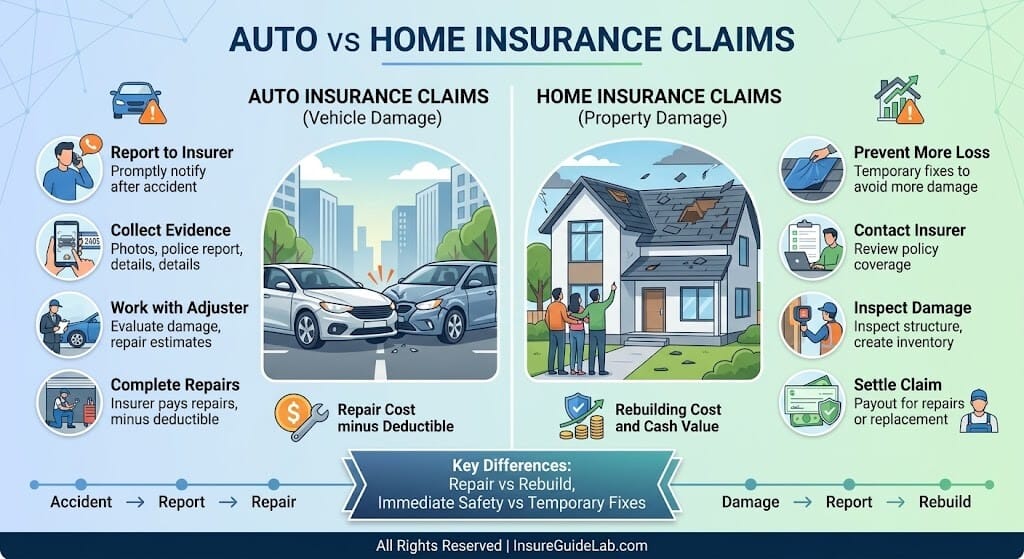
The Insurance Claim Workflow at a Glance
| Stage | Priority Action | Key Deliverable / Requirement |
| 1. At the Scene | Check safety, call first responders | Official Police Report Number |
| 2. Evidence Gathering | Photograph vehicles, exchange contacts | Photos, driver license, insurance card details |
| 3. Claim Initiation | Notify carrier within 24–48 hours | First Notice of Loss (FNOL) & claim number |
| 4. Damage Appraisal | Adjuster inspection or virtual estimate | Itemized repair appraisal / total loss valuation |
| 5. Claim Settlement | Approve repair shop or sign settlement | Deductible payment & direct shop payout |
Step 1: Secure the Scene and Call the Authorities
Your personal safety and legal protection take priority before any insurance paperwork begins.
- Move to Safety: If the vehicles are operable and the roadway is hazardous, pull off to the shoulder or a nearby well-lit parking lot. Turn on hazard warning lights immediately.
- Call Emergency Services (911): Even in seemingly minor fender benders, always request law enforcement to the scene. An official police report is the most credible piece of third-party evidence an insurance claims adjuster will review.
- Avoid Admitting Fault: Maintain composure when speaking with the other driver. Do not apologize or say phrases like “I didn’t see you,” as statements made at the scene can be interpreted as an admission of legal liability.
Step 2: Document Comprehensive Scene Evidence
Thorough photographic documentation minimizes the risk of fraudulent injury claims or conflicting stories between drivers.
- Capture Multi-Angle Photos: Photograph the overall scene layout, skid marks, traffic signals, weather conditions, street signs, and close-up views of damage to all vehicles involved.
- Exchange Essential Driver Details: Collect the other driver’s full legal name, phone number, policy number, insurance carrier name, driver’s license number, and vehicle VIN/license plate.
- Gather Neutral Eyewitness Accounts: If nearby pedestrians or other motorists witnessed the collision, request their names and telephone numbers. Objective third-party statements often resolve disputed fault determinations quickly.
Step 3: Contact Your Insurance Company Promptly
Most auto insurance contracts contain a strict “prompt notification” clause requiring drivers to notify the carrier within 24 to 48 hours of an incident.
- Provide Facts, Not Speculation: Deliver a clear, chronological account of the incident during your First Notice of Loss (FNOL). If you do not know an exact detail, state that clearly rather than guessing speeds or distances.
- Determine First-Party vs. Third-Party Claim:
- First-Party Claim (Your Insurer): If you carry collision coverage and need immediate repairs, filing through your own policy is usually faster. Your insurer will subsequently seek reimbursement from the at-fault driver’s insurer via subrogation.
- Third-Party Claim (At-Fault Driver’s Insurer): If the other party was undeniably at fault and you do not want to pay your upfront collision deductible, you can file directly against their liability coverage.
Step 4: Cooperate with the Claims Adjuster
Once your claim is logged, an insurance claims adjuster will be assigned to evaluate fault, verify coverage terms, and appraise vehicular damage.
- Vehicle Damage Appraisal: The adjuster will inspect the car in person, direct you to a preferred direct-repair program (DRP) body shop, or request digital photos via the insurer’s mobile app.
- Rental Car Coordination: If your policy includes rental reimbursement coverage, ask your adjuster to set up a direct-bill reservation while your vehicle remains in the repair shop.
- Total Loss Determinations: If the cost to restore the vehicle safely exceeds state total-loss thresholds (typically 70% to 80% of Actual Cash Value), the insurer will declare the vehicle a total loss and issue an ACV cash payout.
Step 5: Repair Completion and Settlement Sign-Off
- Selecting Your Body Shop: By law in most jurisdictions, insurance companies cannot force you to use a specific repair facility. You retain the legal right to choose any licensed automotive repair shop.
- Paying Your Deductible: If you filed through your collision or comprehensive policy, you will pay your agreed-upon deductible (e.g., $500 or $1,000) directly to the repair shop upon collecting the restored vehicle.
- Supplemental Claims: If mechanics discover hidden internal frame or mechanical damage after disassembling the car, have the shop submit a supplement directly to the insurance adjuster before finishing repairs.
4 Common Claim Filing Mistakes to Avoid
- Waiting Too Long to Report: Delaying notification beyond your policy’s reporting deadline gives carriers grounds to scrutinize or deny physical damage coverage.
- Accepting Cash at the Scene: Agreeing to settle privately without insurance intervention leaves you vulnerable if the other driver later claims severe bodily injury or backtracks on their agreement.
- Signing Premature Medical Releases: Do not sign complete bodily injury liability releases until all soft-tissue symptoms, medical imaging, and doctor appointments are concluded.
- Ignoring Subrogation Rights: If you paid your deductible on a crash where the other driver was at fault, track your carrier’s subrogation status to ensure your deductible is refunded once they collect from the opposing insurer.
Summary Recommendations
- Keep Policy Information Accessible: Store your digital proof of insurance and carrier roadside assistance number directly in your smartphone wallet.
- Review State Claims Standards: Check state consumer protection regulations, unfair claims settlement laws, and carrier complaint data via the National Association of Insurance Commissioners (NAIC).
Related Guide: Learn how vehicle loan balances are protected during a total loss in our guide on Gap Insurance vs Full Coverage.
Related Guide: Understand how collision and weather hazards differ in our analysis of Comprehensive vs Collision Insurance.
Disclaimer: This guide is provided for educational and informational purposes only. Auto insurance claims procedures, comparative fault laws, and total loss calculation thresholds vary by state and insurance policy contract. Consult your claims adjuster or an attorney for legal advice on disputed liability claims.