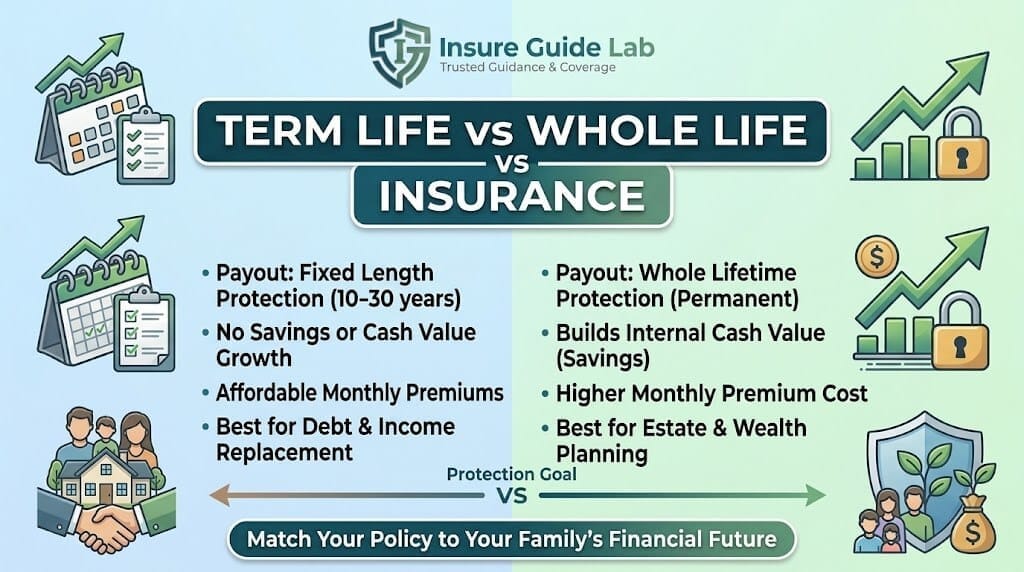
Securing your family’s financial future requires choosing the right balance between cost and long-term protection. When evaluating term life vs whole life insurance, policyholders must decide whether they need straightforward financial defense for a set window of time or lifelong coverage that builds liquid equity.
While both policy structures guarantee a tax-free cash death benefit to your beneficiaries, their cash value mechanics, premium obligations, and expiration terms serve completely different financial strategies.
Quick Comparison: Term Life vs. Whole Life Insurance
| Feature | Term Life Insurance | Whole Life Insurance |
| Coverage Duration | Temporary (10, 20, or 30 years) | Permanent (entire lifetime / age 100+) |
| Cash Value Component | None (pure insurance protection) | Yes (accumulates tax-deferred cash value) |
| Monthly Premium Cost | Low and budget-friendly ($20–$50/mo) | High (typically 5x to 15x more expensive) |
| Premium Stability | Level for the term, then jumps steeply | Locked level premium for life |
| Investment / Loan Feature | None | Policy loans and cash surrenders allowed |
| Primary Financial Role | Income replacement & mortgage defense | Estate planning & permanent legacy transfer |
What Is Term Life Insurance?
Term life insurance is a straightforward life insurance policy designed to cover you for a specific number of years, typically ranging from 10 to 30 years.
- Pure Protection: Every cent paid goes directly toward the cost of insurance and administrative underwriting; there are no attached investment funds.
- Cost-Effective Coverage: Because the insurer only pays out if death occurs within the term window, premiums are extremely affordable, allowing policyholders to buy high face amounts (e.g., $500,000 to $1,000,000+) on modest budgets.
- Defined Horizon: It is engineered to cover peak vulnerability years—such as paying down a 30-year home mortgage or supporting children until they finish college.
What Is Whole Life Insurance?
Whole life insurance is a form of permanent life insurance that guarantees lifelong death benefit protection while building a cash reserve inside the contract.
- Guaranteed Lifelong Coverage: As long as required premiums are paid on schedule, the policy never expires, ensuring a guaranteed eventual death benefit payout.
- Guaranteed Cash Value Growth: A portion of each premium payment flows into a cash value account that grows at a guaranteed minimum interest rate, shielded from market downturns.
- Policy Borrowing Power: Account holders can take loans against their accrued cash value or surrender the policy for liquid cash during retirement.
5 Vital Differences: Term Life vs Whole Life Insurance
1. Policy Duration and Expiration Rules
Term life lasts for a chosen block of time (e.g., 20 years) and expires when the period ends. Whole life provides permanent protection that remains in force for your entire lifetime without renewal deadlines.
2. Premium Price Discrepancy
Whole life insurance routinely costs 5 to 15 times more than term life for the same death benefit amount. This price difference stems from the permanence of the payout and the capital required to fund cash value reserves.
3. Cash Value Accumulation
Term life contains zero cash value; if you outlive the term, the policy terminates with no refund of premiums. Whole life builds tax-deferred cash value that you can access via loans or withdrawals during your life.
4. Financial Objective and Purpose
Term life operates as income replacement protection during working and child-rearing years. Whole life functions primarily as an estate-planning, trust-funding, and wealth-transfer vehicle for permanent financial legacies.
5. Premium Payment Flexibility and Penalties
Missing premium payments on term life simply cancels the policy. On a whole life policy, lapsing in early years can trigger steep surrender penalties and forfeit years of accumulated cash value equity.
Decision Checklist: Which Policy Matches Your Family’s Plan?
Choose Term Life Insurance If:
- [ ] You want maximum death benefit coverage at the lowest possible monthly premium.
- [ ] You need coverage tied to specific debt horizons (like a 15- or 30-year mortgage).
- [ ] You prefer following the “buy term and invest the difference” philosophy in index funds.
Choose Whole Life Insurance If:
- [ ] You have lifelong dependents (such as a child with special needs) requiring permanent security.
- [ ] You have maximized conventional retirement vehicles (401k, IRA, HSA) and seek tax-deferred cash shelters.
- [ ] You need a guaranteed liquidity source to settle future estate taxes and generational inheritances.
Summary Recommendations
- Calculate Your True Replacement Need: Aim for a death benefit equal to 10 to 12 times your annual income during peak dependency periods.
- Include a Conversion Rider: Ensure your term life contract includes a conversion option, enabling you to switch to permanent insurance later without undergoing a medical exam.
- Verify Carrier Solvency: Review financial strength ratings (A.M. Best, S&P) and regulatory compliance data via the National Association of Insurance Commissioners (NAIC).
Related Guide: Learn how high-limit personal coverage safeguards assets in our analysis of Umbrella Insurance vs Excess Liability.
Related Guide: Understand how health savings tools build wealth in our breakdown of HSA vs FSA.
Disclaimer: This guide is provided for educational and informational purposes only. Policy underwriting, cash value interest rates, and loan provisions vary according to state regulations and individual insurance carrier contracts. Consult a licensed life insurance agent or financial planner before purchasing a policy.