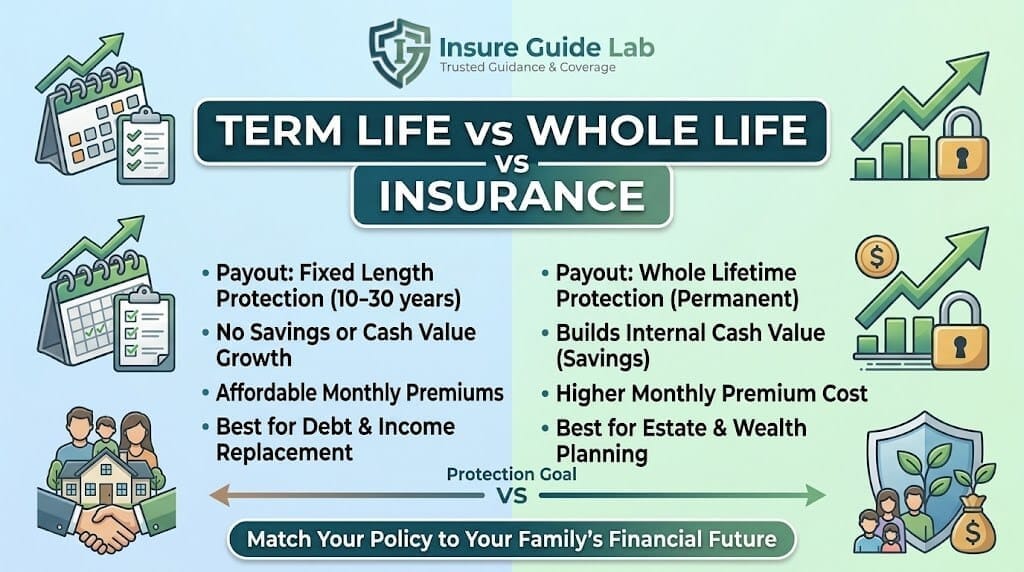
Selecting the appropriate life insurance policy is one of the most critical decisions for securing your family’s financial future. When evaluating term life vs whole life insurance, policyholders must decide whether they need straightforward, budget-conscious protection or lifelong coverage combined with cash value accumulation.
While both policy options provide a tax-free financial payout to your beneficiaries, their duration, monthly premium commitments, and wealth-building mechanics operate entirely differently.
Table of Contents
Quick Comparison: Term Life vs. Whole Life Insurance
| Feature | Term Life Insurance | Whole Life Insurance |
| Coverage Duration | Temporary (Specified term: 10, 20, or 30 years) | Permanent (Guaranteed for your entire lifetime) |
| Monthly Premium Cost | Highly affordable (5 to 15 times cheaper) | Substantially higher fixed premiums |
| Cash Value Growth | None (pure insurance protection only) | Guaranteed cash value growth on a tax-deferred basis |
| Policy Flexibility | Convertible to permanent plans without health exams | Policy loans, cash withdrawals, and dividend options |
| Death Benefit Payout | Paid only if death occurs during the active term | Guaranteed tax-free payout regardless of when you pass away |
| Primary Financial Goal | Income replacement and debt protection during peak years | Estate planning, lifelong wealth transfer, and legacy building |
What Is Term Life Insurance?
Term life insurance is a straightforward life insurance policy designed to provide financial protection for a fixed period of time.
- Fixed Duration Terms: Policies are commonly issued for terms of 10, 15, 20, 25, or 30 years.
- Level Premium Structure: Your monthly premium cost remains locked and guaranteed never to increase throughout the agreed term.
- Pure Income Protection: If the policyholder passes away during the active term, beneficiaries receive the full death benefit payout completely tax-free.
- Term Expiration: If you outlive the policy term, coverage ceases unless you renew or convert it to a permanent plan.
What Is Whole Life Insurance?
Whole life insurance is a permanent life insurance contract that remains in force for your entire lifetime, provided scheduled premiums are paid.
- Lifelong Guaranteed Coverage: The death benefit is guaranteed to payout to your heirs regardless of your age at passing.
- Guaranteed Cash Value Accumulation: A portion of each premium payment builds equity in a tax-advantaged cash value account.
- Living Policy Benefits: Policyholders can borrow against the accumulated cash value via low-interest policy loans for emergencies or retirement funding.
- Mutual Company Dividends: Many participating insurers distribute annual dividends that can be taken as cash or used to purchase paid-up additions.
5 Essential Differences: Term Life vs Whole Life Insurance
1. Cost and Premium Affordability
Term life insurance delivers significantly higher coverage limits for a fraction of the cost. Whole life insurance premiums can be 5 to 15 times more expensive for the exact same death benefit dollar amount.
2. Duration of Financial Protection
Term policies are engineered to cover temporary liabilities—such as a 30-year home mortgage or child education expenses. Whole life insurance guarantees permanent coverage across your entire life expectancy.
3. Cash Value and Wealth Accumulation
Term life has no savings component; it is pure protection. Whole life builds guaranteed cash value that grows tax-deferred and can be accessed during your lifetime.
4. Complexity and Management
Term life insurance is transparent, straightforward, and easy to maintain. Whole life insurance involves surrender charges, dividend structures, interest rate crediting, and loan repayment terms.
5. Conversion and Flexibility Privileges
Most quality term life policies include conversion riders, allowing you to transition into a permanent whole life plan later without undergoing medical underwriting.
Decision Checklist: Which Policy Fits Your Financial Strategy?
Choose Term Life Insurance If:
- [ ] You want the highest possible death benefit coverage for the lowest monthly cost.
- [ ] You need coverage specifically to protect a mortgage, personal debts, or children’s college years.
- [ ] You prefer investing discretionary cash independently into high-growth retirement accounts (IRAs / 401ks).
Choose Whole Life Insurance If:
- [ ] You require lifelong coverage for estate tax liquidity or special needs trust funding.
- [ ] You want guaranteed, conservative cash accumulation unaffected by stock market fluctuations.
- [ ] You have already maxed out all traditional tax-advantaged retirement accounts.
Summary Recommendations
- Calculate True Income Replacement Needs: Most financial planners recommend securing a death benefit equal to 10 to 12 times your annual gross salary.
- Review Conversion Windows: If you buy term insurance today, ensure the contract offers guaranteed conversion privileges to permanent coverage before age 65.
- Verify Insurer Financial Solvency: Check historical claim-paying ability and financial strength ratings through the National Association of Insurance Commissioners (NAIC).
Related Guide: Learn how high-limit secondary protection defends your accumulated family assets in our analysis of Umbrella Insurance vs Excess Liability.
Related Guide: Understand how wage replacement safeguards your living expenses in our comparison of Short-Term vs Long-Term Disability Insurance.
Disclaimer: This guide is provided for educational and informational purposes only. Life insurance underwriting requirements, dividend performance, and tax implications vary by jurisdiction and carrier. Consult a certified financial planner or licensed life insurance agent before purchasing coverage.