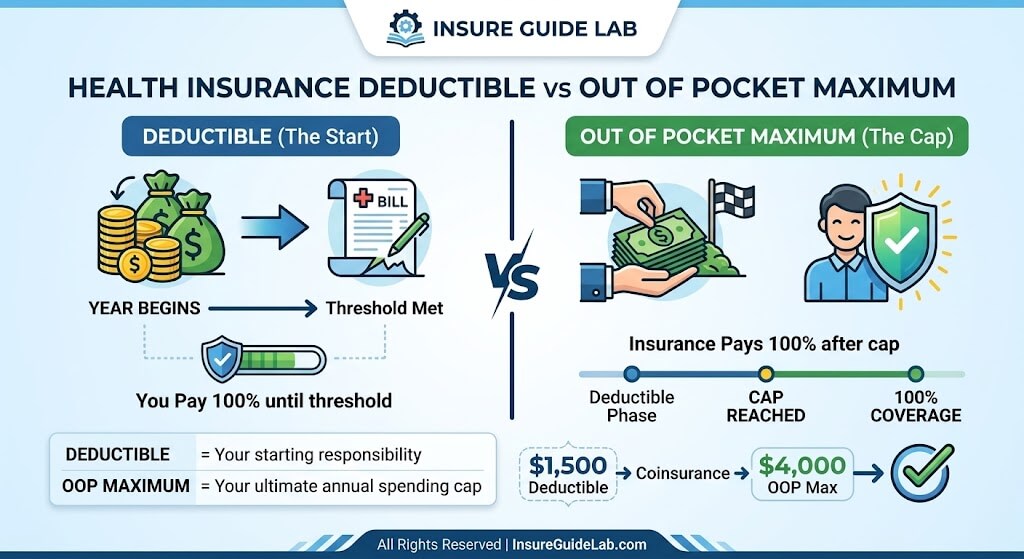
Navigating health insurance cost structures often feels overwhelming, especially when managing medical bills or choosing a workplace benefit plan. The core relationship between a deductible vs out of pocket maximum determines exactly how much you must pay before insurance begins covering your healthcare costs.
Confusing these two terms can lead to significant budgeting mistakes during unexpected medical emergencies.
Quick Comparison: Deductible vs. Out-of-Pocket Maximum
| Feature | Health Insurance Deductible | Out-of-Pocket Maximum |
|---|---|---|
| Definition | The upfront amount you pay before coverage starts | The absolute maximum financial limit you pay per year |
| Insurance Contribution | 0% (You pay 100% of contracted rates) | 100% covered by insurer after reaching limit |
| Coinsurance Phase | Begins immediately after meeting the deductible | Ends completely once this maximum cap is hit |
| Includes Premiums? | No (Monthly premiums do not count) | No (Only direct medical costs apply) |
| Average Cost Range | $1,500 – $5,000+ per individual | $4,000 – $9,200+ per individual |
What Is a Health Insurance Deductible?
A health insurance deductible is the predetermined dollar amount you must pay out-of-pocket for eligible medical services each policy year before your insurer begins to share the costs.
How Deductibles Work:
- The 100% Stage: If your deductible is $2,000 and you receive an in-network hospital bill for $1,200, you pay the entire $1,200.
- Preventive Care Exemption: Under standard healthcare guidelines, qualifying routine checkups, mammograms, and vaccinations are covered 100% before you satisfy the deductible.
What Is an Out-of-Pocket Maximum?
An out-of-pocket maximum is the safety net ceiling of your health insurance policy. It represents the most money you will have to pay for covered in-network medical services within a single calendar year.
How the Out-of-Pocket Maximum Works:
- All payments made toward your deductible, copayments, and coinsurance contribute toward reaching this cap.
- Once your combined spending hits the out-of-pocket maximum, the health insurance company pays 100% of all covered in-network medical bills for the remainder of the year.
The 3 Phases of Health Insurance Cost Sharing
Understanding how money flows from a deductible to an out-of-pocket maximum requires looking at the claim progression:
- Phase 1 (Deductible): You pay 100% of medical bills at the insurer’s contracted rate until you hit your deductible limit.
- Phase 2 (Coinsurance & Copays): After meeting your deductible, cost sharing begins. You pay a percentage (e.g., a 20% coinsurance) while your insurer covers the remaining 80%.
- Phase 3 (Out-of-Pocket Max Reached): Once your cumulative payments equal the out-of-pocket maximum, your coinsurance drops to 0%, and the insurer covers 100% of all eligible medical expenses.
5 Practical Differences to Know
- Payment Timing: You hit your deductible early in treatment, whereas the out-of-pocket maximum serves as catastrophe protection.
- Cost Sharing Trigger: Meeting the deductible activates cost sharing; meeting the out-of-pocket maximum eliminates cost sharing.
- Monthly Premium Exclusion: Monthly plan premiums never count toward satisfying either limit.
- Out-of-Network Rules: Non-network providers typically do not count toward your in-network out-of-pocket maximum.
- Family vs. Individual Caps: Family plans feature aggregate or embedded deductibles that must be monitored separately.
Summary Checklist
- [ ] Checked whether your health plan uses individual or embedded family deductibles.
- [ ] Verified that all ongoing prescriptions and regular doctors are inside the network.
- [ ] Set aside emergency savings equal to at least your annual out-of-pocket maximum.
Related Guide: To optimize pre-tax savings for high-deductible plans, check out our breakdown on HSA vs FSA Difference and Rules.
Related Guide: For network-specific rules, read our comparison on HMO vs PPO Health Insurance.
Disclaimer: This guide is provided for educational and informational purposes only. Specific health plan parameters, deductibles, and cost-sharing maximums vary by employer plan and insurance carrier. Review your official policy summary for exact details.